unexplained.im
Loch Ness: the water, the reports, and the later checks
The loch is a real place in the Great Glen — long, deep, and holding more fresh water than any other British lake. People have also reported a creature in it. This site gives those reports fairly, then sets them beside what later searches, photographs and DNA work were actually able to show.
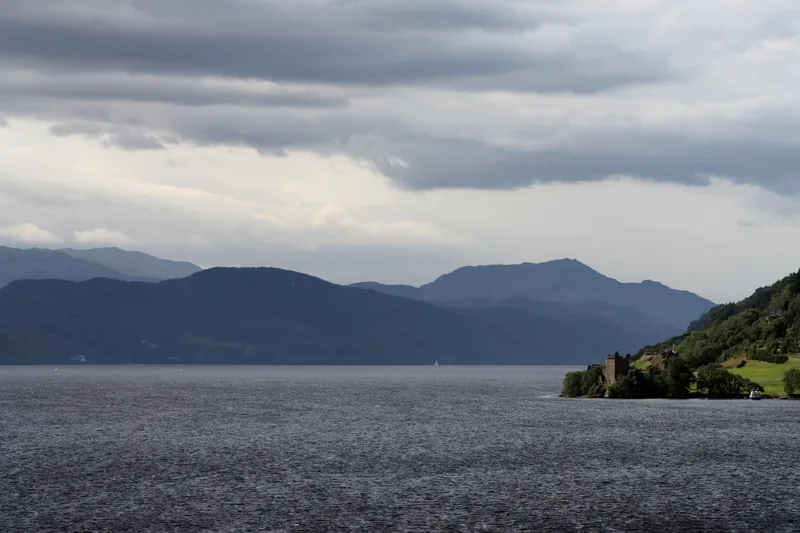
The loch itself
A long, deep body of water
The Gazetteer for Scotland says Loch Ness runs for 23 miles (37 km) south-west to north-east along the Great Glen from Fort Augustus.1 The UK Lakes Portal gives a fetch distance of 36.32 km, a perimeter of 80 km, and a water-body volume of 7,304,034,672 cubic metres.2
Sources differ. The Gazetteer for Scotland gives the length as 23 miles (37 km). The UK Lakes Portal lists a fetch distance of 36.32 km. This site keeps both figures in view.
The loch is a steep-sided trough. Sources give a maximum a little above or a little below 230 m; the disagreement is on the page, not hidden in a single official figure.
The Gazetteer for Scotland records that the maximum depth, just to the south-west of Urquhart Castle, is at least 230 m (754 feet).1 The UK Lakes Portal gives a mean depth of 132.0 m and a maximum depth of 229.8 m.2 Ian Young and Adrian Shine, writing up a 1991 bathymetric and seismic survey, say that although Loch Morar is deeper (310 m), Loch Ness — with a Murray and Pullar maximum of 230 m — has the greatest mean depth (132 m) and hence the greatest volume, 7.452 billion cubic metres, of all British lakes.3
Sources differ. The Gazetteer says the maximum depth is at least 230 m (754 feet). The UK Lakes Portal lists 229.8 m. Young and Shine’s 1991 survey recorded 226.96 m in the North Basin, a little less than Murray and Pullar’s 230 m. This site keeps the disagreement in view.
The Gazetteer for Scotland also says Loch Ness holds the greatest volume of water of any loch in Scotland, and “contains more water than in all of the lakes of England and Wales put together.”1 The UK Lakes Portal lists the surface area of Loch Ness as 5,533 hectares.2 The UK Lakes Portal places the loch at an elevation of 17 m above Ordnance Datum.2
The geography of the loch is not in dispute. The reported creature is. The evidence board below is the working part of the site: each card keeps “what was reported” and “what later checks showed” in view, and you can filter the full board without losing the list.
The evidence board
Seven well-known reports, with the later checks beside them
Each card keeps both sides in view. Filter the full board, or read the same cards as a static list — nothing is hidden if you prefer not to use the buttons.
1933: Aldie Mackay and the Courier
What was reported Alec Campbell, the Inverness Courier’s Fort Augustus correspondent, reported a sighting by Aldie Mackay of a whale-like creature and water “cascading and churning.” The editor, Evan Barron, suggested calling the beast a “monster.”
What later checks showed This is the report BBC News treats as the start of the modern newspaper story. It is a witnessed claim, written up at the time, not a later identification of an animal.
Sourced wording BBC News says the modern story gathered pace when, in 1933, the Inverness Courier’s Fort Augustus correspondent, Alec Campbell, reported a sighting by Aldie Mackay of what she believed to be Nessie. Campbell described a whale-like creature and the loch’s water “cascading and churning.” The editor, Evan Barron, suggested the beast be described as a “monster.”4
1933: Mr and Mrs George Spicer
What was reported They told newspapers they saw a monster, 40 to 50 ft (12 to 15 m) long, crossing the road near the loch, then disappearing into the water.
What later checks showed The BBC records this as one of the well-known 1930s reports, in a period that also produced hoaxes. No physical remains were produced.
Sourced wording The same BBC page records that in 1933 Mr and Mrs George Spicer told newspapers they saw a monster, measuring 40 to 50 ft (12 to 15 m) long, crossing the road near the loch.5
1934: the “Surgeon’s Photograph”
What was reported Colonel Robert Wilson was said to have photographed the monster on 19 April 1934. For sixty years it was the most famous picture of “Nessie.”
What later checks showed In 1994 it was revealed to be a hoax: a toy submarine bought from Woolworths, with a head of wood putty, given to Wilson after earlier “Nessie footprints” had been ridiculed. This site does not reproduce the copyrighted picture; the later check is the point.
Sourced wording In 1994, the BBC records, the most famous of the published photographs — taken by Colonel Robert Wilson on 19 April 1934 — was revealed to be a hoax.5
1970s: a flipper in a photograph
What was reported A photograph associated with Dr Robert Rhines — the BBC’s spelling — seemed to show a flipper or fin. Sir Peter Scott gave the creature the name Nessiteras rhombopteryx.
What later checks showed The BBC notes that the name is also an anagram of “Monster hoax by Sir Peter S,” and that the image was later revealed to have been computer enhanced.
Sourced wording It also records that in the 1970s a photograph taken by Dr Robert Rhines — the BBC’s spelling — attracted worldwide attention and seemed to show a flipper or fin. The creature was given the scientific name Nessiteras rhombopteryx by Sir Peter Scott. The BBC notes that the name is also an anagram of “Monster hoax by Sir Peter S,” and that the image was later revealed to have been computer enhanced.5
1987: Operation Deepscan
What was reported A line of boats with echo sounders swept the loch. Three sonar contacts were of interest; they were stronger than ordinary fish echoes and, when revisited, had disappeared.
What later checks showed The Loch Ness Project says they were certainly not 10-metre monsters, and that the contacts remain unexplained. Sources disagree on whether twenty or 24 boats took part.
Sourced wording When interesting contacts were revisited, most proved to be fixed, but three had disappeared. The Project says they were “certainly not 10 metre monsters,” yet were stronger than fish echoes and lay far deeper. “The contacts remain unexplained.”6
2003: a BBC sonar search
What was reported Programme-makers carried out what the BBC called the most extensive search yet, with 600 separate sonar beams and satellite navigation.
What later checks showed They found nothing. That is a later check of the water column, not a verdict on every earlier report.
Sourced wording In July 2003, the BBC says, programme-makers carried out what it calls the most extensive search yet, using 600 separate sonar beams and satellite navigation technology, but found nothing.5
2019: environmental DNA
What was reported A University of Otago team, led by Professor Neil Gemmell, sampled water across the loch to catalogue living species from environmental DNA.
What later checks showed No evidence of a plesiosaur, sturgeon, catfish or Greenland shark was found. There was a great deal of eel DNA; the work does not give the eels’ size, and does not discount unusually large eels.
Sourced wording In 2019, BBC News reported work led by Professor Neil Gemmell of the University of Otago, which tried to catalogue living species in the loch from environmental DNA in water samples. No evidence of a prehistoric marine reptile called a plesiosaur, or of a large fish such as a sturgeon, was found. Catfish, and the idea of a wandering Greenland shark, were also discounted.4
Photograph dossiers
Famous pictures are described here, not reproduced when the licence is unclear. The later checks — a toy submarine in 1934, a computer-enhanced flipper in the 1970s — are the part we can source.
Dossier 1 · 19 April 1934
The “Surgeon’s Photograph”
In 1994, the BBC records, the most famous of the published photographs — taken by Colonel Robert Wilson on 19 April 1934 — was revealed to be a hoax.5 The same report says the 1934 “Surgeon’s Photograph” was, sixty years later, confirmed as a hoax hatched in revenge after a newspaper ridiculed journalist Marmaduke Wetherell for finding “Nessie footprints” on the shore. The “monster” caught on camera was apparently a toy submarine bought from Woolworths, with a head fashioned from wood putty, and the hoaxers then gave the photograph to Wilson.4
The picture itself is not shown here. It is still widely circulated, and the later check — a toy submarine with a wood-putty head — is the part this site can stand over with a named source.
Dossier 2 · 1970s
A flipper, a name, and an enhancement
It also records that in the 1970s a photograph taken by Dr Robert Rhines — the BBC’s spelling — attracted worldwide attention and seemed to show a flipper or fin. The creature was given the scientific name Nessiteras rhombopteryx by Sir Peter Scott. The BBC notes that the name is also an anagram of “Monster hoax by Sir Peter S,” and that the image was later revealed to have been computer enhanced.5
Dossier 3 · A tradition, given fairly
St Columba and a “water beast”
BBC News traces the story back 1,500 years, when the Irish missionary St Columba is said to have encountered a beast in the River Ness in 565 AD. That is a reported tradition about a river encounter, given here with the later newspaper history, not as proof of an unknown animal in the loch.4 The Gazetteer notes a much earlier story: St Columba (521–597) is said to have subdued a mysterious “water beast.” The site treats that as a reported tradition, not as a zoological record.1
These are reported traditions about a holy man and a river or loch beast, written down long after the fifth and sixth centuries. They are part of how the story is told, and they are not a modern natural-history record of the loch.
Where to go next
The evidence board
Seven well-known reports, each with the later check kept beside it.
The loch itself
Length, depth and volume — and the places the sources disagree.
Photograph dossiers
Famous pictures described, not reproduced, with what later checks found.
Expeditions
Deepscan in 1987, a BBC sonar search in 2003, and the fish the Project could count.
Environmental DNA
What a 2019 water-sample survey could and could not find.
The 1930s wave
Mackay, Spicer, and why two good sources disagree about the year it began.
Urquhart Castle
The ruin on the shore, and why so many searches mention the water below it.
Fact-check log
Every sourced sentence on this site, with the page it was checked against.
Printables
Download packs follow the same sourced wording as this site. Prices are in US dollars.
The Loch Ness Reference Guide
A fact-checked 11-page guide to the loch itself, the well-known reports, the later checks, and where the sources disagree.
11 pages, A4 and US Letter
The Loch Ness Activity Pack
A 7-page pack: a 14-question sourced quiz, a sources-differ worksheet, an evidence-board writing table, a loch-profile exercise and photograph-dossier prompts, following the wording used on loch-ness.unexplained.im.
7 pages, A4 and US Letter
Expeditions and Later Checks
A 6-page companion to Operation Deepscan, the 2003 BBC search and the 2019 environmental-DNA work, with a comparison table and a 12-item fact-check list.
6 pages, A4 and US Letter
The Complete Loch Ness Printables Bundle
All three packs — 24 pages in A4 and in US Letter — at a bundle price. Credited photographs of the real loch, not drawings of a creature.
24 pages in A4 and in US Letter
Books and guides
Affiliate links to Amazon UK searches, not endorsements of particular titles. These are books and guides to the real loch, the castle and Highland natural history — not novelty monster toys sold as evidence. As an Amazon Associate I earn from qualifying purchases.
- Natural history of Loch Ness (affiliate link) The loch as a body of water, and what is known to live in it.
- Urquhart Castle guides (affiliate link) The ruin on the north shore, in the care of Historic Environment Scotland.
- The Caledonian Canal (affiliate link) The waterway that raised the loch’s level and still runs through the Great Glen.
- Environmental DNA (affiliate link) The method behind the 2019 survey of the loch.
Sources on this page
- Gazetteer for Scotland, Loch Ness
- UK Lakes Portal, Loch Ness (water body 18767)
- Young and Shine, Loch Ness bathymetric and seismic survey, 1991
- BBC News, 5 September 2019, “Loch Ness Monster may be a giant eel, say scientists”
- BBC On This Day, 11 October 1987, “Search ends for Loch Ness monster”
- Loch Ness Project, Operation Deepscan