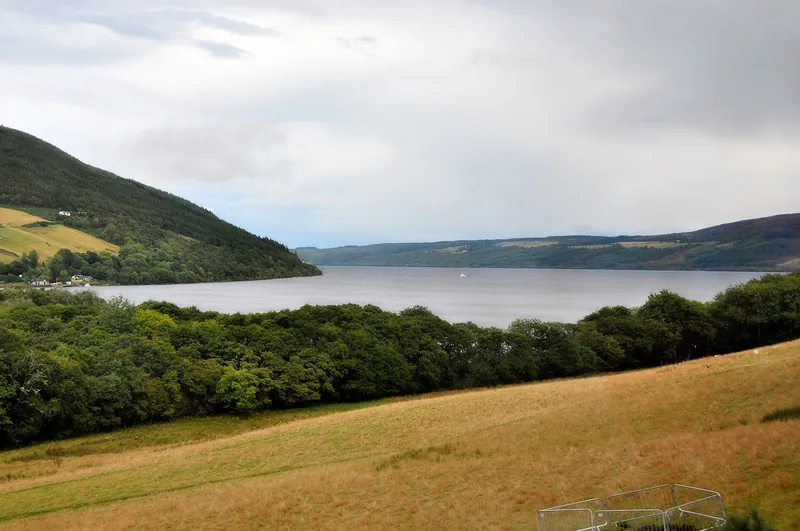
Before the reports, the water: a long, steep-sided loch in the Great Glen, on the line of the Caledonian Canal.
Looking along Loch Ness from the shore, photographed by Herbert Frank.Photo: Herbert Frank · CC BY 2.0 · Commons
The Gazetteer for Scotland says Loch Ness runs for 23 miles (37 km) south-west to north-east along the Great Glen from Fort Augustus.1 The loch lies on the route of the Caledonian Canal. During the canal’s construction, the Gazetteer says, the level of the loch was raised by 3 m (9 feet) to ease navigation.1
Sources differ. The Gazetteer for Scotland gives the length as 23 miles (37 km). The UK Lakes Portal lists a fetch distance of 36.32 km. This site keeps both figures in view.
The UK Lakes Portal gives a fetch distance of 36.32 km, a perimeter of 80 km, and a water-body volume of 7,304,034,672 cubic metres.2 The UK Lakes Portal lists the surface area of Loch Ness as 5,533 hectares.2 The UK Lakes Portal places the loch at an elevation of 17 m above Ordnance Datum.2
The loch itself
A long, deep body of water
The Gazetteer for Scotland says Loch Ness runs for 23 miles (37 km) south-west to north-east along the Great Glen from Fort Augustus.1 The UK Lakes Portal gives a fetch distance of 36.32 km, a perimeter of 80 km, and a water-body volume of 7,304,034,672 cubic metres.2
Sources differ. The Gazetteer for Scotland gives the length as 23 miles (37 km). The UK Lakes Portal lists a fetch distance of 36.32 km. This site keeps both figures in view.
Fort AugustusAbout 36–37 kmTowards Inverness
SurfaceAbout 227–230 m
The loch is a steep-sided trough. Sources give a maximum a little above or a little below 230 m; the disagreement is on the page, not hidden in a single official figure.
The Gazetteer for Scotland records that the maximum depth, just to the south-west of Urquhart Castle, is at least 230 m (754 feet).1 The UK Lakes Portal gives a mean depth of 132.0 m and a maximum depth of 229.8 m.2 Ian Young and Adrian Shine, writing up a 1991 bathymetric and seismic survey, say that although Loch Morar is deeper (310 m), Loch Ness — with a Murray and Pullar maximum of 230 m — has the greatest mean depth (132 m) and hence the greatest volume, 7.452 billion cubic metres, of all British lakes.3
Sources differ. The Gazetteer says the maximum depth is at least 230 m (754 feet). The UK Lakes Portal lists 229.8 m. Young and Shine’s 1991 survey recorded 226.96 m in the North Basin, a little less than Murray and Pullar’s 230 m. This site keeps the disagreement in view.
The Gazetteer for Scotland also says Loch Ness holds the greatest volume of water of any loch in Scotland, and “contains more water than in all of the lakes of England and Wales put together.”1 The UK Lakes Portal lists the surface area of Loch Ness as 5,533 hectares.2 The UK Lakes Portal places the loch at an elevation of 17 m above Ordnance Datum.2
The Gazetteer for Scotland records that the maximum depth, just to the south-west of Urquhart Castle, is at least 230 m (754 feet).1 Their 1991 survey found a maximum depth in the North Basin of 745 feet (226.96 m), a little less than the Murray and Pullar maximum of 754 feet (230 m), and about a kilometre south of Urquhart Castle.3
Sources differ. The Gazetteer says the maximum depth is at least 230 m (754 feet). The UK Lakes Portal lists 229.8 m. Young and Shine’s 1991 survey recorded 226.96 m in the North Basin, a little less than Murray and Pullar’s 230 m. This site keeps the disagreement in view.
Ian Young and Adrian Shine, writing up a 1991 bathymetric and seismic survey, say that although Loch Morar is deeper (310 m), Loch Ness — with a Murray and Pullar maximum of 230 m — has the greatest mean depth (132 m) and hence the greatest volume, 7.452 billion cubic metres, of all British lakes.3 The Gazetteer for Scotland also says Loch Ness holds the greatest volume of water of any loch in Scotland, and “contains more water than in all of the lakes of England and Wales put together.”1
Later work by the Project completed the first quantitative acoustic estimates of the open-water fish population and found only about 20 tonnes.4
English racing driver John Cobb died on the loch in 1952, the Gazetteer records, while trying to break the water-speed record.1
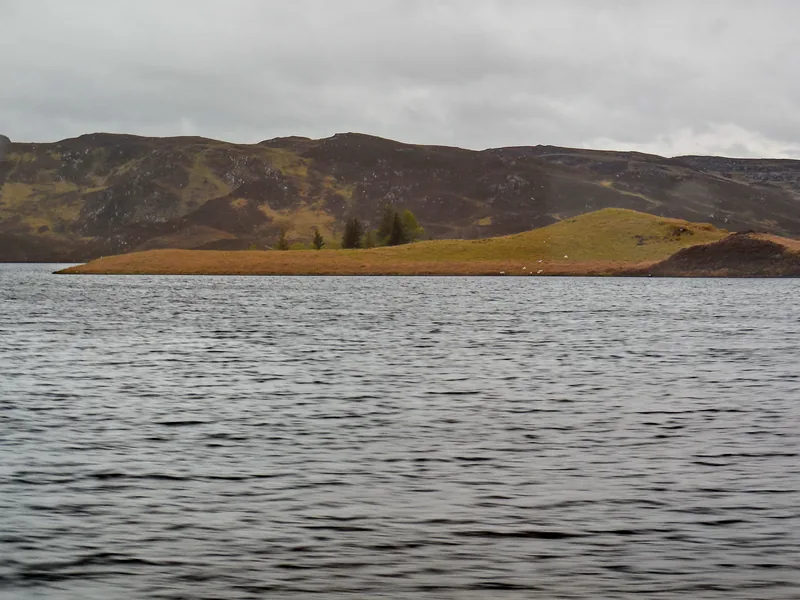
Loch Ness, photographed by Tanya Dedyukhina.Photo: Tanya Dedyukhina · CC BY 3.0 · Commons
The Project’s later acoustic work found only about 20 tonnes of open-water fish. That is not a remark about a monster; it is a remark about how much food the open water seems to hold.